

Lower back pain is undoubtedly the most common ailment in adults. Although there are still doubts about the cause of the complaint, it’s been linked to the intervertebral discs and there are several observations that support this theory (e.g. subjects suffering from a herniated disc generally have lower back pain before the onset of the injury).
The development of abdominal muscles is decisive in preventing and even curing these injuries (in the case of minor pathologies).
Disc pressure
The most typical abdominal exercise, the “crunch”, corresponds to the highest percentage of pressure on the intervertebral discs, meaning it’s really not suitable for this type of pathology. Likewise, exercises with straight legs, big planks or core rotations also put the back health at risk of those injured with fissures, protrusions or herniated discs.
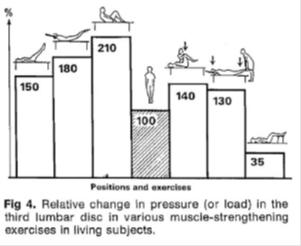
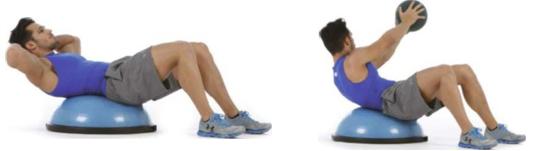
In cases of lower back injuries, which are not uncommon, it may be better to perform alternative exercises, such as crunches with raised legs, or on unstable platforms, which have been shown to activate the entire core musculature to a greater degree.
Potential benefits of abdominal exercises for back problems
- Increased fluid flow and nutrition to the discs. Lumbar flexion improves nutrient delivery to the discs by increasing fluids.
- Increased tissue remodelling. With proper planning, spinal flexion exercises strengthen your disc tissues, thereby increasing your tolerance to the lumbar flexion exercise and preventing future injuries.
- Sagittal plane mobility. Some studies have linked lack of spinal mobility to lower back pain, although the literature is somewhat conflicting. At the very least, crunches can prevent a loss of spinal mobility, which turns out to be important in preventing lower back pain.
- Rectus abdominis hypertrophy. Dynamic exercise is superior to isometric exercise in increasing muscle mass. Much of this has to do with the increased muscle damage achieved from eccentric activity as well as increased metabolic stress. Crunches or movements with spine flexion will help to optimise the appearance of the “six-pack”, although they should be combined.
- Performance improvement. Contrary to what some have claimed, lumbar flexion is common in many sports activities (eg swimming turns, martial arts…)
Therefore, concentric-eccentric cycles to strengthen the abdominals may very well lead to increased athletic performance.
Sources
- Behm, D. G., Drinkwater, E. J., Willardson, J. M., & Cowley, P. M. (2010). Canadian Society for Exercise Physiology position stand: The use of instability to train the core in athletic and nonathletic conditioning. Applied Physiology, Nutrition, and Metabolism, 35(1), 109-112.
- Contreras, B. & Schoenfeld, B. To Crunch or Not to Crunch. www.t-nation.com. Retrieved 13 September 2014 from http://www.t-nation.com/free_online_article/most_recent/to_crunch_or_not_to_crunch&cr=
- Endleman, I., & Critchley, D. J. (2008). Transversus abdominis and obliquus internus activity during pilates exercises: measurement with ultrasound scanning. Archives of physical medicine and rehabilitation, 89(11), 2205-2212.
- Escamilla, R. F., Lewis, C., Bell, D., Bramblet, G., Daffron, J., Lambert, S., … & Andrews, J. R. (2010). Core muscle activation during swiss ball and traditional abdominal exercises. Journal of orthopaedic & sports physical therapy, 40(5), 265-276.
- Sánchez, D. (2014). El Gran Libro de los Abdominales y Core. Sportlife supplement, March 2014.
- Vera-García, F. J., Flores-Parodi, B., Elvira, J. L., & Sarti, M. Á. (2008). Influence of trunk curl-up speed on muscular recruitment. The Journal of Strength & Conditioning Research, 22(3), 684-690.







The information below is required for social login
Sign In
Create New Account